
Play Dragon's Treasure Now!
Home → Strategy
Dragon's Treasure Strategy
Approaching Dragon's Treasure sensibly
Dragon's Treasure by Merkur Gaming presents a theoretical return of 95.56%, which establishes a house edge of 4.44% for the player over extended play sessions. This specific RTP configuration is lower than the more commonly cited default setting of 96.84%, meaning the casino retains a larger percentage of wagers on this particular version. Players must recognize that the mathematical advantage favors the house significantly more here than in slots with higher returns, impacting long-term bankroll sustainability.
The game features a maximum win cap of 5,000x the stake, which provides a clear upper limit for potential payouts during any single session or winning streak. Unlike Blazing Star from the same developer, which also offers a 5,000x max win but operates with medium-high volatility, Dragon's Treasure maintains a low volatility profile. This structural difference means wins occur more frequently but are generally smaller, requiring patience rather than expecting large, rare jackpots to sustain engagement.
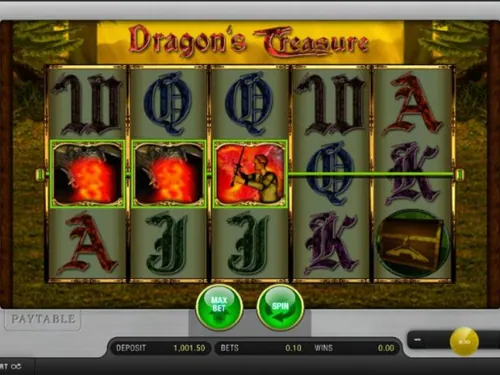
Released in 2015, this slot utilizes a standard 5x3 reel layout with exactly five paylines, creating a simple mechanical structure that lacks complex side bets or multi-line strategies. The absence of additional betting layers keeps the decision-making process straightforward, allowing players to focus entirely on the base game and the free spins feature. This simplicity ensures that every spin contributes directly to the known RTP without introducing unpredictable variance from bonus buy options or progressive mechanics.
Bankroll rules that hold up
A strict flat betting strategy is essential when playing Dragon's Treasure because its low volatility generates frequent small wins that can deplete a bankroll if stakes fluctuate. By maintaining the same stake every round, players avoid the trap of progressive staking, which only accelerates the time to ruin without altering the built-in 4.44% house edge. Consistency allows the theoretical 95.56% RTP to manifest gradually, preventing early exhaustion of funds due to emotional betting decisions after minor losing streaks.
The minimum bet of 0.05 units allows for an extended number of spins before the bankroll is exhausted, which is crucial for experiencing the full cycle of the game's features. With five paylines active, each spin costs at least 0.25 units total, determining the baseline cost per round for budget planning purposes. This low entry point enables players to absorb the variance inherent in the low volatility design while waiting for the expanding symbols trigger during free spins.
Free spins are triggered by landing three or more Dragon Wild/Scatter symbols, awarding ten spins where expanding symbols can significantly boost payout potential without additional wagering. These free rounds provide value that extends the effective lifespan of the initial deposit, as no further money is required to access the highest paying feature. Players should view these ten spins as a critical component of the overall return, since they offer a chance to hit the 5,000x cap risk-free.
The gamble or double-up feature introduces a binary risk element that can quickly reverse gains made during the base game or free spins if used incorrectly. Since this feature is optional, prudent bankroll management dictates avoiding it unless the player is willing to forfeit the current win entirely for a chance to double it. Engaging with the gamble feature does not improve the underlying RTP and often leads to faster depletion of the session budget compared to closing out wins.
Bet sizing against volatility
Low volatility in Dragon's Treasure implies that wins happen regularly but are typically close to the stake size, requiring a larger bankroll to survive dry spells between bigger combinations. A common mistake is betting too high relative to the bankroll, assuming the frequent hits will sustain play indefinitely without accounting for the 4.44% house edge compounding over time. Smaller bets preserve capital longer, allowing the statistical return to stabilize rather than suffering rapid loss from variance spikes despite the low volatility classification.
The five payline structure limits the complexity of betting strategies, as players cannot adjust line counts to alter risk profiles like they might in multi-payline slots. Every spin activates all five lines, meaning the total bet is simply the line stake multiplied by five, which simplifies calculations for tracking losses versus winnings. This fixed structure ensures that the volatility remains consistent regardless of the bet level, making bet sizing purely a function of available funds rather than strategic adjustment.
Comparing Dragon's Treasure to Blazing Star highlights how volatility affects bet sizing, as the latter's medium-high rating demands larger buffers to withstand longer losing streaks. While Blazing Star offers similar max wins, its higher volatility means players must accept greater risk per spin to chase those payouts, whereas Dragon's Treasure offers steadier, smaller returns. Adjusting bet sizes downward in Dragon's Treasure compensates for the lower variance, ensuring that the bankroll lasts long enough to potentially trigger the free spins feature.
The theoretical RTP of 95.56% serves as the ultimate benchmark for evaluating whether a chosen bet size aligns with long-term expectations of return. Players who increase their stakes to win faster ignore the mathematical reality that the house edge applies equally to every unit wagered, regardless of bet magnitude. Maintaining a modest bet size respects the game's design, allowing the low volatility to smooth out results while minimizing the impact of the 4.44% disadvantage on the total bankroll.
Session limits worth setting
Setting a time limit is advisable when playing Dragon's Treasure because its engaging free spins feature with expanding symbols can lead to prolonged periods of continuous play. Without a predefined end point, the combination of low volatility and frequent small wins can create a false sense of security, encouraging players to continue beyond their intended duration. A strict time boundary prevents fatigue-induced errors and ensures that the session concludes before the 4.44% house edge erodes the remaining bankroll significantly.
A loss limit based on a percentage of the initial bankroll helps protect funds from being wiped out during inevitable losing streaks, even in a low volatility slot. For instance, stopping after losing 50% of the starting balance preserves half the resources for future sessions, acknowledging that the 95.56% RTP guarantees eventual return only over infinite time. This rule enforces discipline, ensuring that short-term variance does not override the long-term mathematical expectation of the game.
Win goals should be defined clearly, such as aiming to reach 150% of the starting bankroll before ending the session, to lock in profits before they are given back to the casino. The 5,000x max win represents a rare outlier event, so realistic targets should focus on achievable gains through the regular payout structure and free spins bonuses. Securing a predetermined profit prevents the temptation to reinvest winnings into the gamble feature, which statistically reduces the final account balance over repeated attempts.
The ten free spins awarded upon triggering the scatter feature provide a natural break point in gameplay, offering a risk-free opportunity to accumulate additional credits. Players can choose to end their session immediately after these spins conclude, effectively capping their exposure to the base game's house edge for that round. Utilizing this feature as a milestone marker helps maintain control over spending habits, turning a random bonus event into a structured decision point for continuing or stopping play.
Why chasing losses fails
Chasing losses by increasing bet sizes after a deficit ignores the fundamental truth that each spin in Dragon's Treasure is an independent event with a fixed 4.44% house edge. Raising stakes to recover lost money does not change the probability of winning or the expected return, which remains anchored to the 95.56% RTP regardless of previous outcomes. This behavior merely accelerates the rate at which the bankroll decreases, transforming a manageable low-volatility game into a high-risk scenario that guarantees faster financial ruin.
The low volatility of Dragon's Treasure creates an illusion of control, as frequent small wins mask the gradual erosion of funds caused by the house edge over time. Players may feel compelled to bet more aggressively to achieve a significant win that offsets earlier losses, failing to recognize that the 5,000x max win is statistically rare and not influenced by bet size adjustments. Such emotional responses contradict the mathematical reality that past results have no bearing on future spins, leading to irrational decision-making that harms the bankroll.
Progressive staking systems that raise bets after losses are mathematically flawed because they do not alter the built-in advantage held by the casino in every single wager. In Dragon's Treasure, where the RTP is 95.56%, no betting pattern can overcome the negative expectation, and increasing stakes only increases the absolute amount lost per hour of play. Accepting the loss limit and stepping away preserves the remaining bankroll for future sessions, acknowledging that variance is uncontrollable and only time and discipline mitigate its effects.
The presence of the gamble feature tempts players to risk existing wins in an attempt to recoup losses, which further compounds the damage caused by chasing deficits. Each use of the double-up option carries a 50% risk of losing the entire amount won, adding unnecessary variance to an already predictable low-volatility game. Avoiding this feature protects accumulated profits and reinforces the principle that recovery from losses is best achieved by stopping play rather than attempting to beat the system through increased aggression.
Dragon's Treasure: key facts
| Parameter | Value |
|---|---|
| Game | Dragon's Treasure |
| Studio | Merkur Gaming |
| Released | 2015 |
| RTP | 95.56% |
| House edge | 4.44% |
| Volatility | low |
| Max win | 5,000x |
| Reels | 5x3 |
| Paylines / ways | 5 |
| Bet range | 0.05 – — |
Common systems and their limits
Dragon's Treasure by Merkur Gaming offers a 5x3 reel layout with exactly 5 paylines, creating a simple structure for players to analyze. The theoretical RTP of 95.56% indicates a house edge of 4.44%, which is higher than the 96.84% configuration often cited in other Merkur titles like Alles Spitze. This variance means that standard betting patterns cannot overcome the built-in mathematical disadvantage over extended play sessions.
The maximum win cap stands at 5,000x the total stake, providing a clear ceiling for potential payouts regardless of the betting strategy employed. In contrast, Alles Spitze from edict e-gaming under the Merkur brand caps wins at only 500x, making Dragon's Treasure significantly more lucrative for high-variance outcomes. Players must recognize that this limit applies strictly to the slot mechanics and excludes any external bonus multipliers.
Free spins are triggered by landing three or more Dragon Scatter symbols, awarding 10 spins with expanding symbols to increase hit potential. This feature interacts with the low volatility setting, ensuring frequent but smaller returns rather than rare massive jackpots. Consequently, bankroll management requires steady flat betting to survive the dry spells between these special symbol activations during gameplay.
Flat betting explained
Flat betting involves wagering the same stake every round, ranging from a minimum of 0.05 € up to unspecified higher limits on Dragon's Treasure. This method aligns well with the game's low volatility profile, allowing players to extend their session time without rapid depletion of their bankroll funds. By maintaining a constant bet size, players avoid the psychological traps associated with chasing losses after inevitable losing streaks occur.
Unlike progressive strategies, flat betting does not alter the inherent house edge of 4.44% derived from the 95.56% RTP figure provided by Merkur Gaming. The predictable nature of this approach helps players track their expenditure accurately against the 5,000x max win potential without emotional interference. This stability is crucial for managing expectations when playing slots with fixed payline structures rather than complex way-to-win matrices.
The gamble or double-up feature allows players to risk winnings after a win, adding an optional layer of excitement to the otherwise steady gameplay loop. However, engaging with this feature introduces additional variance that contradicts the core principles of strict flat betting discipline. Responsible players should view this option as a separate decision point rather than an integral part of their base betting strategy.
Progressive staking risks
Progressive staking raises stakes after losses, a tactic that fundamentally shortens the time to ruin despite appearing logical to inexperienced gamblers. On Dragon's Treasure, increasing bets during cold streaks accelerates the drain of the bankroll due to the fixed 4.44% house edge remaining unchanged. This mathematical reality ensures that no betting system can convert negative expectation into positive long-term profit over thousands of spins.
Merkur Gaming designed the slot with low volatility, meaning large swings in balance are less common but still possible within the 5,000x win limit. Attempting to recover losses through aggressive stake increases often leads to exceeding the maximum bet constraints or depleting funds before hitting a winning combination. This risk is exacerbated by the absence of any cash-out mechanism typical in crash games, leaving players vulnerable to sudden reversals.
Comparatively, games like Alles Spitze with high volatility and a 90.85% RTP present different risk profiles, yet progressive staking remains dangerous across all variants. The 5 payline structure of Dragon's Treasure offers limited ways to hit winning combinations, making recovery through increased stakes statistically improbable. Players relying on such systems often find themselves unable to sustain play during the inevitable periods of below-average return rates.
What the maths actually allows
The theoretical return of 95.56% implies that for every 100 € wagered, the game retains 4.44 € on average over millions of spins. This calculation defines the long-term cost of entertainment, establishing a baseline expectation that prevents players from viewing the 5,000x max win as achievable frequently. Understanding this metric helps manage financial expectations and reduces the likelihood of chasing unrealistic payout scenarios during individual gaming sessions.
Alternative configurations citing 96.56% or 96.84% RTP suggest variability in how Merkur Gaming may have deployed the software across different jurisdictions or platforms. Regardless of the specific percentage, the house edge remains a persistent factor that erodes bankrolls over time, necessitating strict loss limits. Players should verify which version they are accessing, as the difference between 95.56% and 96.84% represents a significant variance in expected value.
The 5x3 reel layout with 5 paylines creates a straightforward probability matrix that influences hit frequency and average win sizes significantly. Low volatility settings ensure that wins occur relatively often, but their magnitude is typically small relative to the total stake placed. This design encourages longer play sessions while limiting the potential for substantial profits, aligning with the casino's goal of sustained engagement.
Learning the game in demo first
Merkur Gaming released Dragon's Treasure in 2015 as a five-reel slot featuring only five paylines, which simplifies the initial learning curve for new players compared to complex video slots. This streamlined layout allows users to focus on the core mechanics without being overwhelmed by excessive winning combinations or confusing symbol interactions during their first attempts at gameplay.
The theoretical return to player stands at 95.56%, while other configurations circulate at 96.84% or 96.56%, establishing a house edge between 3.16% and 4.44% depending on the specific server settings. Players should verify the exact percentage before playing, as this variance directly impacts long-term bankroll preservation and determines the expected loss rate per thousand spins over extended sessions.
In contrast to high-variance titles like Book of Dead with its 96.21% RTP and high volatility, Dragon's Treasure offers low volatility that produces frequent but smaller wins to sustain play. This structural difference means demo practice here focuses on managing stake sizes rather than chasing rare jackpot hits, providing a safer environment to understand the expanding symbol mechanics without rapid balance depletion.
Adjusting stakes to your budget
The minimum bet starts at 0.05 credits per spin, allowing players with small bankrolls to endure the low-volatility nature of the game through hundreds of rounds without significant financial risk. This entry-level stake ensures that even conservative players can experience the full feature set, including the free spins round triggered by three or more scatter symbols appearing anywhere on the reels.
With a maximum win cap of 5,000x the total bet, a player wagering the highest possible amount could theoretically secure a substantial payout, though the low volatility makes such outcomes statistically rare events. Flat betting strategies work best here because progressive staking systems increase exposure to the 4.44% house edge without altering the underlying mathematical expectation of each individual spin outcome.
Unlike Book of Dead which features high volatility requiring larger buffers for dry spells, Dragon's Treasure demands less capital resilience due to its steady win frequency and lower risk profile. This characteristic enables players to allocate a fixed daily budget more predictably, knowing that losses will accumulate gradually rather than through sudden large deficits associated with high-variance gaming products.
Recognising a bad session
A session becomes problematic when the cumulative loss approaches the predefined bankroll limit, particularly given the 95.56% RTP which guarantees a slow bleed over thousands of spins regardless of short-term luck. Players must monitor their remaining funds against the 0.05 minimum bet to determine if they can afford ten more spins, ensuring they do not chase losses beyond their initial financial commitment.
The gamble or double-up feature introduces additional risk by allowing players to forfeit recent winnings for a chance to multiply them, potentially accelerating the depletion of the session budget significantly faster than base play. Since this feature does not alter the overall RTP, engaging it repeatedly during a losing streak merely speeds up the realization of the negative mathematical expectation inherent in the game design.
Compared to the volatile swings seen in Book of Dead where wins are sparse but large, Dragon's Treasure offers a deceptive sense of control through frequent small payouts that mask the steady erosion of funds. Recognizing this pattern early prevents emotional decision-making, as the low volatility creates an illusion of safety while the 4.44% house edge continues to extract value from the player's account balance steadily.
Stopping while ahead
The maximum win potential of 5,000x represents the upper boundary of profitability, meaning any session exceeding this threshold relative to the starting bankroll indicates exceptional luck rather than sustainable strategy. Players should consider withdrawing profits once they reach a significant multiple of their initial deposit, as the low volatility structure suggests that further play will likely revert toward the mean return of 95.56%.
Free spins awarded via the scatter feature provide ten additional rounds with expanding symbols, offering a concentrated period of enhanced winning potential that differs from the base game's standard payout structure. Securing these bonus rounds often correlates with temporary profit spikes, making it an optimal moment to evaluate whether to continue playing or lock in gains before the volatility resets.
While Book of Dead offers similar max win caps, its high volatility means players rarely see consistent returns, whereas Dragon's Treasure provides more regular feedback that encourages continued engagement despite the negative expectancy. Setting a strict profit target based on the 96.84% RTP configuration helps players maintain discipline, ensuring they leave the table with positive results rather than surrendering all accumulated value to the house edge.
Responsible play in practice
Dragon's Treasure operates with a theoretical RTP of 95.56%, implying that for every 100 credits wagered, approximately 95.56 credits are returned to players over millions of spins, leaving a 4.44% retention rate. Understanding this long-term average prevents misconceptions about short-term wins, reinforcing the need for strict bankroll management and pre-commitment limits to avoid gambling beyond one's financial means.
The presence of a gamble feature allows players to risk existing wins, which can quickly negate previous profits if used impulsively during a losing streak or after a small gain. Responsible practitioners treat this optional mechanic as entertainment rather than a recovery tool, recognizing that it adds no strategic value and only increases the variance of their immediate financial outcome without improving odds.
Casinos often offer bonuses like 300% welcome matches up to 2,000 euros, but these terms require substantial turnover that interacts poorly with low-volatility games like Merkur Gaming's title. Players must calculate the required wagering volume against the slower win frequency of Dragon's Treasure to ensure they can meet conditions without depleting their bonus funds through inevitable house edge application.
DemoRTP & VolatilitySymbols & PayoutsBonus FeaturesStrategyBonusesMobileDownload & AppMax WinSimilar GamesReviewFAQSitemap
Dragon's Treasure 2026